Reniway Edge Architecture
From fragmented machine data to scalable industrial intelligence.
The bottleneck in most factories is not analytics. It is reliable, contextualized industrial data. Reniway Edge collects from machines of any age, standardizes them into one namespace, analyzes the stream as it arrives, and serves the result to dashboards and your other systems. It runs on one appliance on your own network: your machinedata stays on site and a fleet of devices is managed and patched from one place.
The problem this solves
Machines, PLCs, suppliers, data formats and customer environments rarely agree with each other. That fragmentation is what makes digital initiatives slow, custom, expensive and hard to scale, long before anyone gets to the analytics.
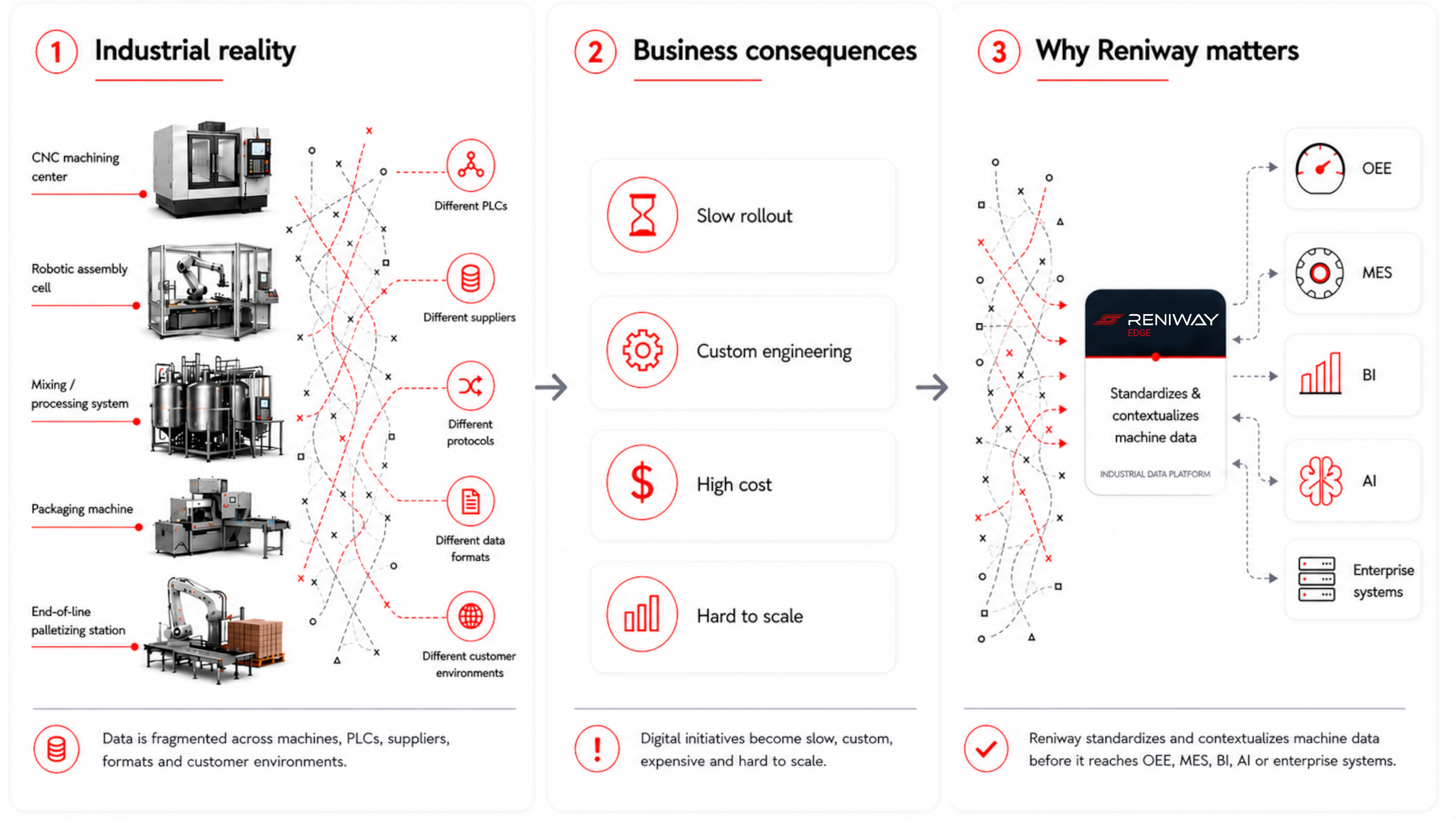
Reniway standardizes and contextualizes machine data before it reaches OEE, MES, BI, AI or enterprise systems, turning it into a reusable data foundation rather than another point solution. In one OEM program, that replaced custom engineering with reusable product infrastructure, so a new installation became a configuration exercise instead of a project.
Connect what you already have
Most plants are a mix: a machine bought last year that speaks OPC UA, and one from 1998 with a serial port and an opinion. Both hold data worth having, and replacing the old one to get at it is rarely the business case.
| Family | Examples |
|---|---|
| Industrial standards | OPC UA, MQTT, Modbus, Ethernet/IP, MT-Connect |
| Controller-specific | Beckhoff TwinCAT ADS, SINUMERIK, FANUC FOCAS, HEIDENHAIN DNC |
| Retrofit sensors | Vibration, sound, temperature, energy (for machines that expose nothing) |
| Systems and databases | SQL, InfluxDB, Redis, MES and maintenance systems |
Connectivity is configuration, not a development project. See Connectors.
Configure one, export it as a template (a YAML file holding the connectors, data mappers, transformations and OPC UA nodes) and upload it to recreate the whole set in one go.
Standardize into one namespace
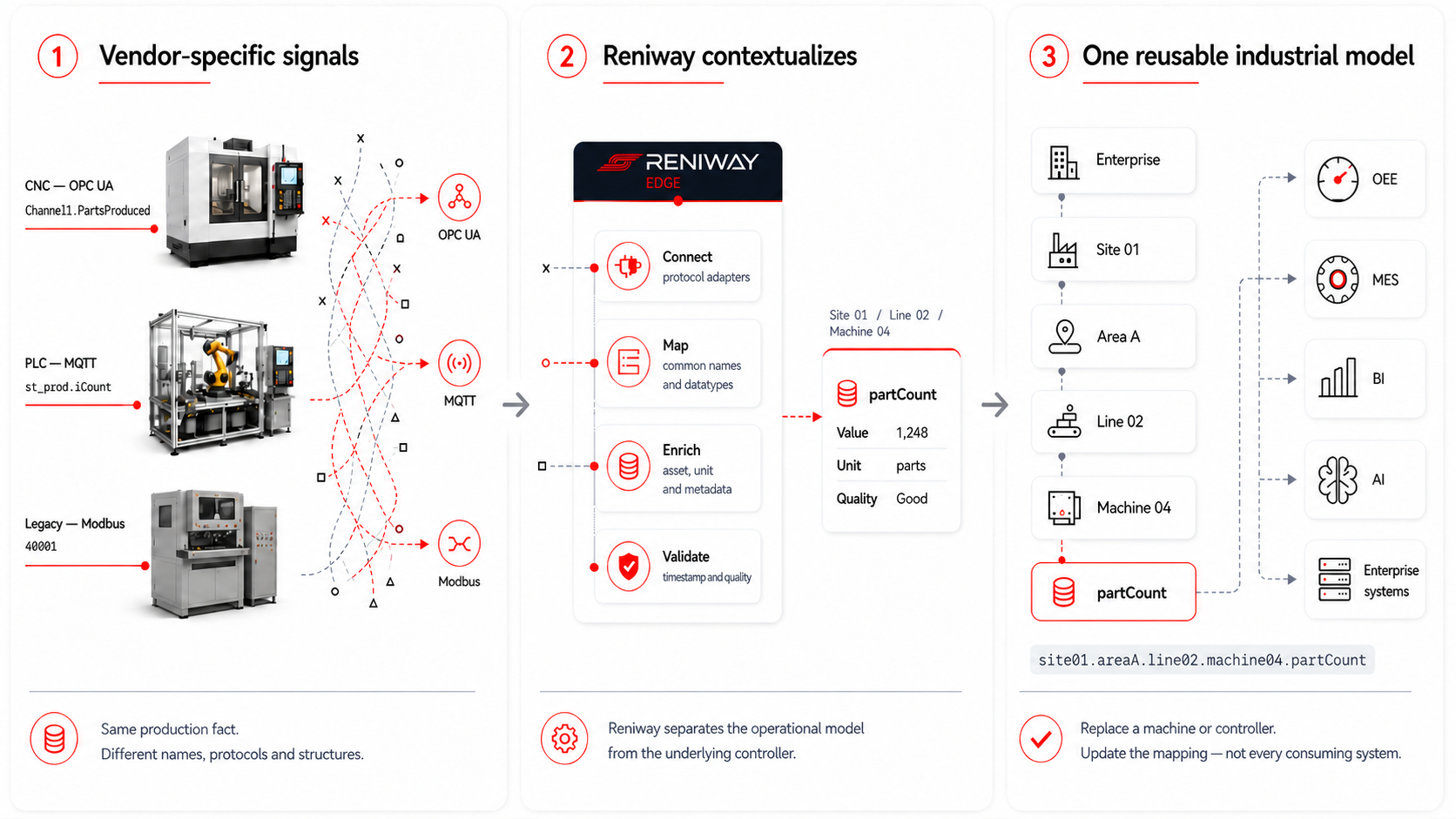
One controller calls it Channel1.PartsProduced, the next st_prod.iCount, the old one register
40001. Anything built directly on those names breaks when the machine is replaced.
Data mappers resolve that into one model that is the same across every machine: a unified namespace. Vendor tags are renamed, units and datatypes normalized, and machine states and alarm codes mapped onto a common set of labels.
Analyze at the edge
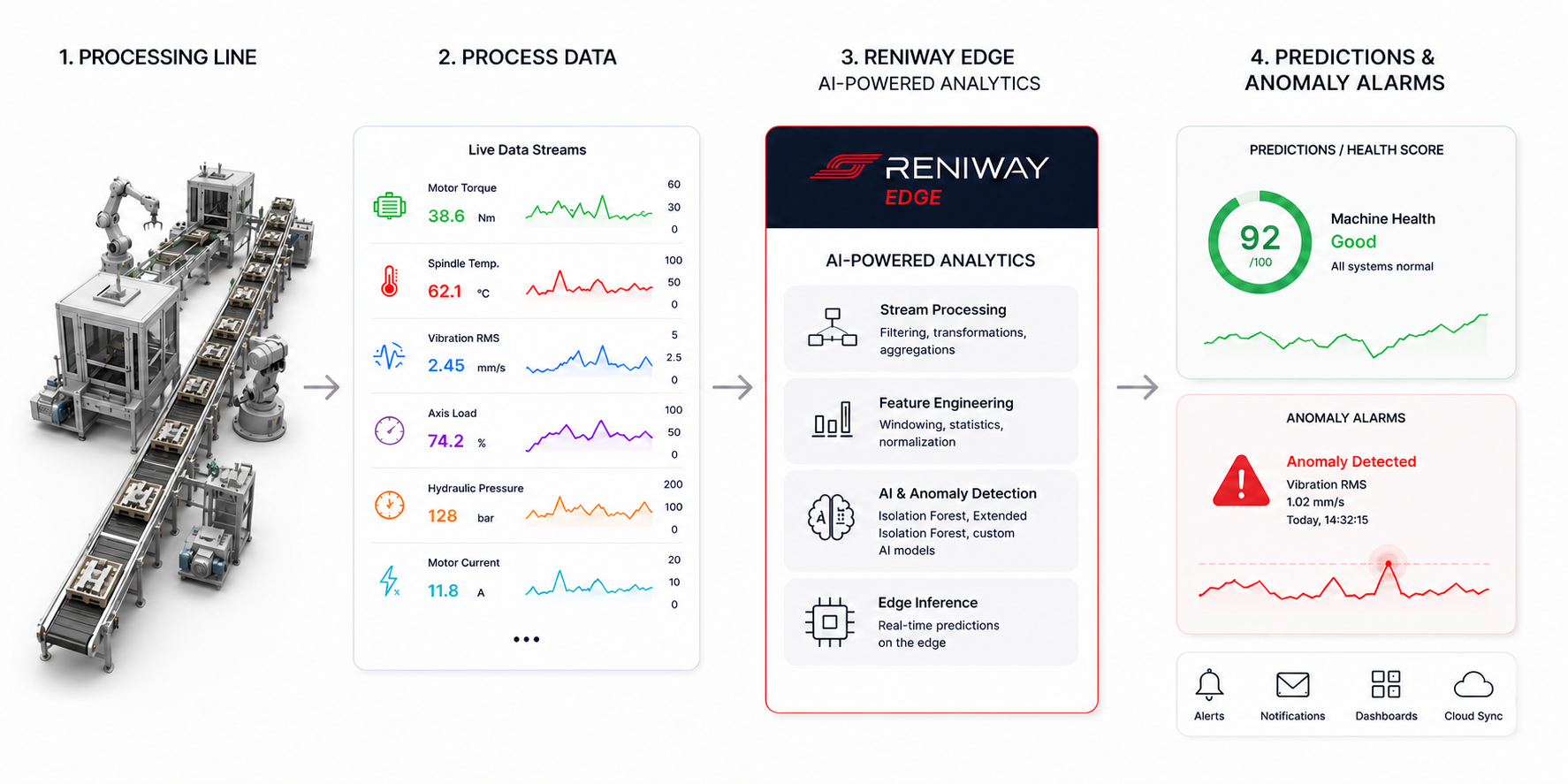
Not every question should wait for a round trip to a data center. Reniway runs the analytics where the data is produced.
| Stage | What happens |
|---|---|
| Stream processing | Filtering, transformations and aggregations on live values as they arrive. |
| Feature engineering | Windowing, statistics and normalization, so raw samples become something a model can use. |
| AI and anomaly detection | Isolation Forest, Extended Isolation Forest and custom models flagging behavior that departs from normal. |
| Edge inference | Predictions calculated on the device, in real time. |
The results are first-class values: a health score or a detected anomaly can be stored, charted, raised as an alarm, pushed as a notification, or published back out over OPC UA or MQTT like any other value. KPIs (availability, utilization, yield, OEE) are calculated against the standardized model, so they are defined once and mean the same thing on every line.
Calculating here keeps latency low enough to act on, keeps working when the network does not, and ships conclusions upstream instead of raw sample streams.
CNC machining. Anomaly detection across energy consumption, axis and spindle load, operational data and program information produces a daily report of parts that deviated, so tooling, fixtures or material can be corrected early, cutting scrap risk and shortening the hunt for process issues.
Pump monitoring. Low-cost vibration, sound, temperature and magnetic-field sensors on ship-to-tank transfer pumps, with runtime data and anomaly alarms fed straight into the customer's cloud maintenance management system.
Store and visualize
Data lands in PostgreSQL with TimescaleDB on the appliance: time-series in hypertables partitioned by time, master data in ordinary tables beside it. It is plain PostgreSQL: your BI tool, a Python script or a warehouse ingestion job can read it directly, with no proprietary format and no export step.
Grafana ships with the stack at https://[HOST]/dashboards and queries that database in SQL, so
there is no second copy to fall behind. Dashboards are delivered as versioned configuration, not
hand-built on the box, so a set can be rolled out to another line and a change can be rolled back.
Labels can be driven from translation tables for multi-language operator screens, the appliance can
drive a plant-floor display directly, and the included report service renders PDFs from the same
data. See Included components.
How long history is kept is a per-project setting agreed with you, not a platform default.
Deployment and fleet management
Reniway Edge is deployed as a self-contained physical appliance or virtual machine on the plant network. The application services run as containers on a hardened Linux operating system, while database, configuration and application data are kept separately so they survive application updates.
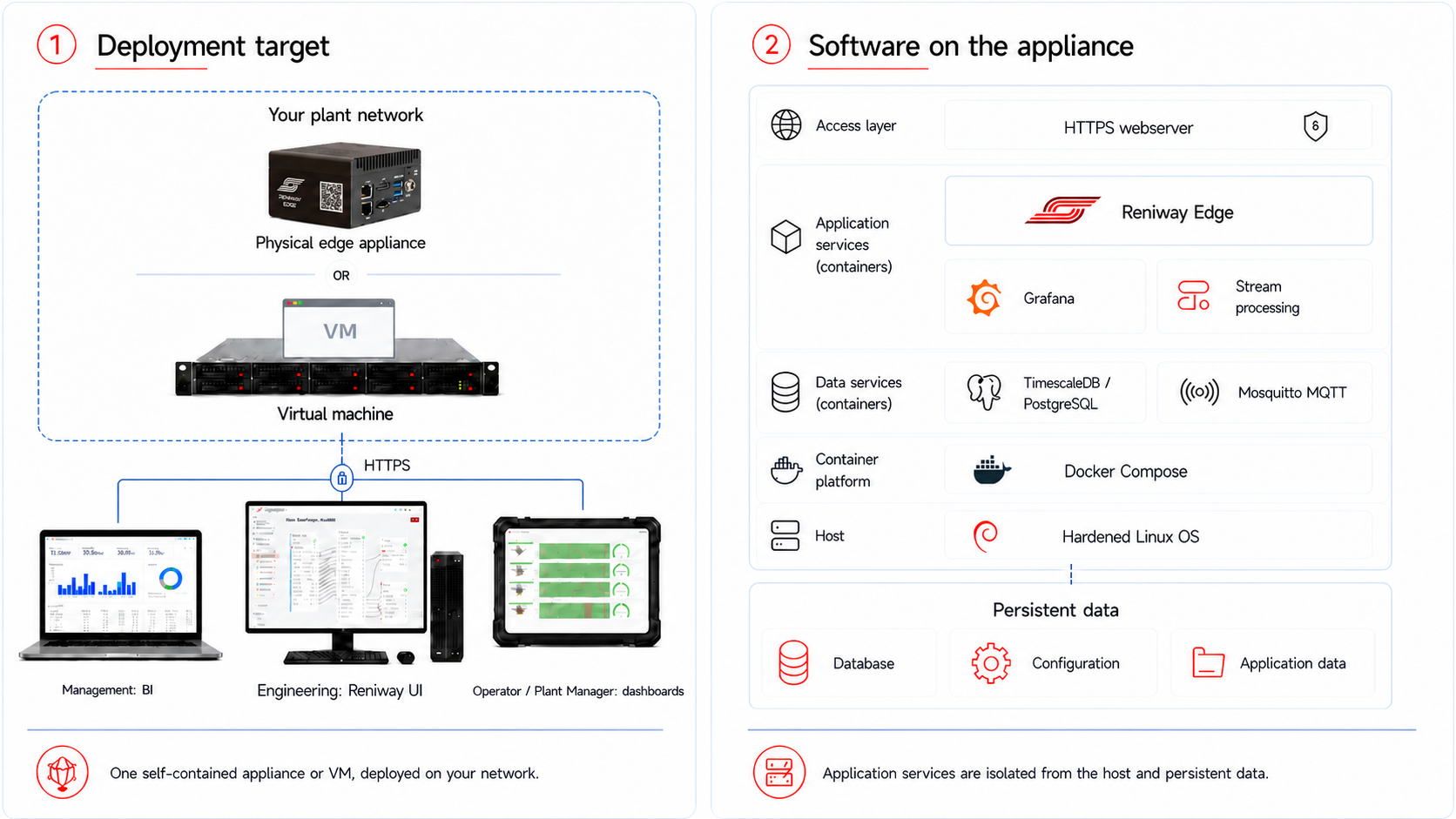
One appliance is a project; twenty is an estate. Reniway Edge treats a device as three independently versioned parts, so an OS security patch does not disturb a dashboard change:
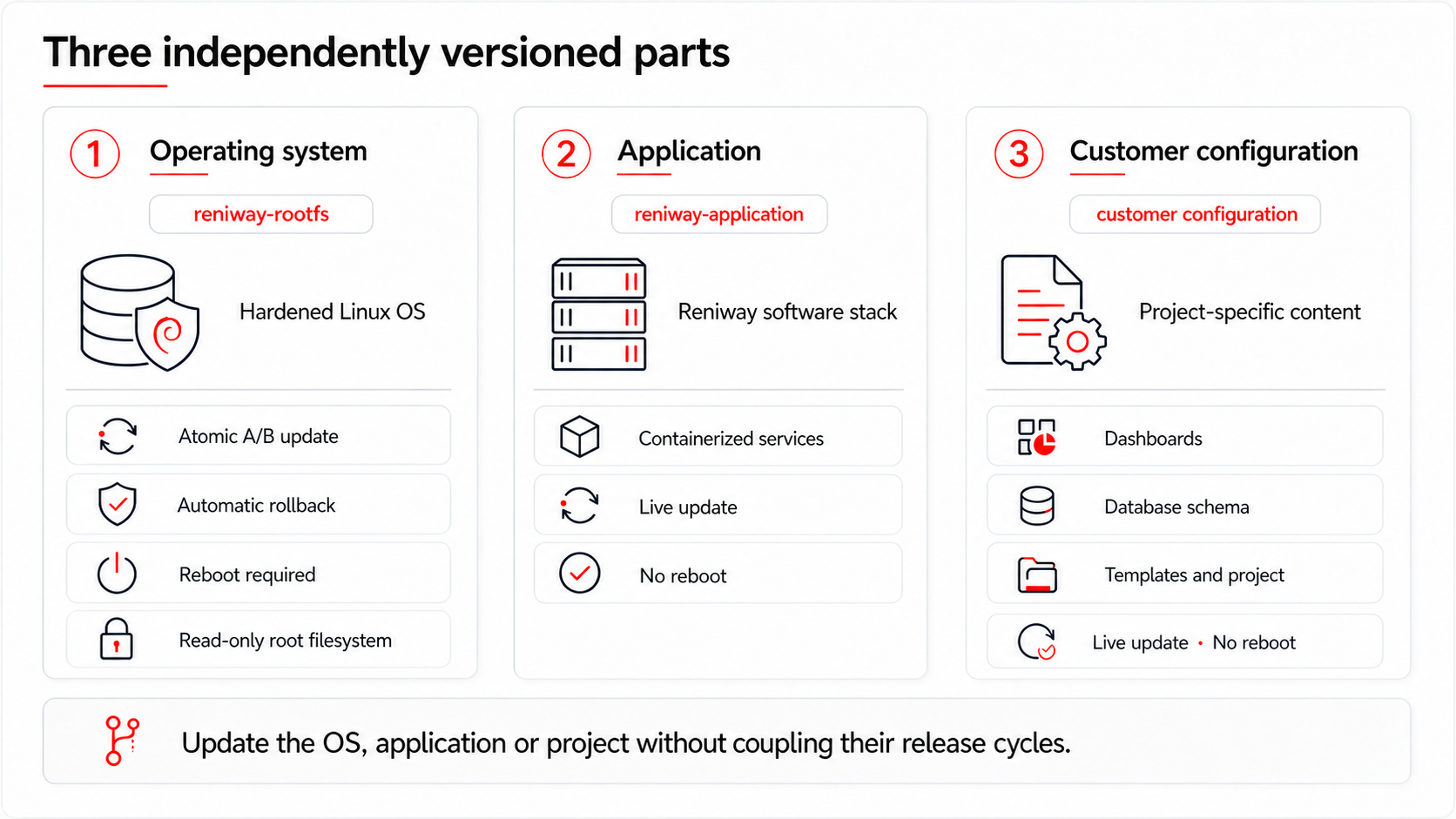
Reniway Cloud is the optional management layer: it answers which release is available to which device and from when, which is what makes staged rollouts and pilot groups possible. It collects no machine data and cannot act on a device by itself. Cloud controls what is available; the operator controls when. Devices without internet are commissioned from a USB stick and updated through their own local interface; the cloud path is automation on top of that, not a dependency.
Security
| Layer | What protects it |
|---|---|
| Device | Hardened Linux, read-only root. The running system cannot be changed in place. |
| Updates | Signed and verified on the device. Unsigned is refused. |
| Protocols | HTTPS for the interface, OPC UA certificate trust, MQTT over TLS with authentication. |
| People | Named accounts with per-area View / Manage permissions. |
| Data | Stays on your network. It leaves only over integrations you configure. |
A 1998 controller cannot be encrypted, and no platform changes that. Reniway terminates those protocols at the edge and re-publishes over authenticated ones, so the unencrypted hop is a short cable inside your plant, not a path across your network.
Contact sales@reniver.eu to walk through your target environment, network topology, or a specific integration requirement.